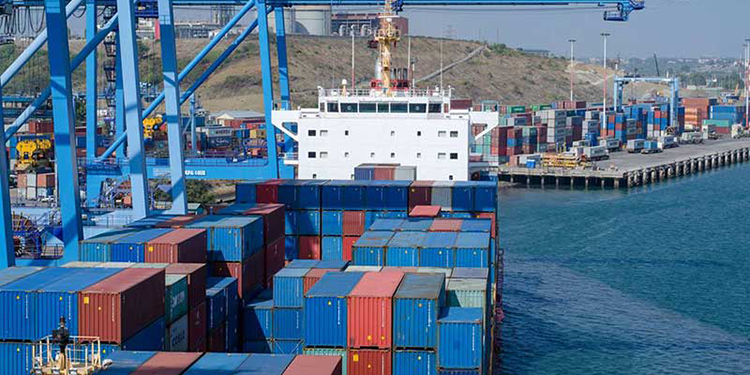
The Kenya Ports Authority recently issued a new directive on the delivery of export containers aimed at improving operational efficiency at the Port of Mombasa.
A notice to stakeholders outlined new guidelines as part of ongoing efforts to facilitate smoother movement of export cargo through the port.
Under the new directive, general dry export containers will be delivered through Gate 24, Lane 23A, while reefer export containers will be delivered through Gate 24, Lane 23B. In addition, general export containers for both dry cargo and reefers will also be handled through Gate 94.
In the notice signed by Managing Director William Ruto, KPA further indicated that the Port of Mombasa will begin accepting export containers within 24 hours after vessel berthing. This is intended to support timely cargo delivery and improve vessel turnaround time as well as overall handling efficiency.
“All exporters, transporters, clearing and forwarding agents, and other port users are requested to strictly utilize the designated gates and lanes to facilitate orderly, safe, and efficient export cargo operations,” the notice stated.
Fredrick Aloo, National Chairman of the Kenya International Freight and Warehousing Association (KIFWA), welcomed the move, noting that it reflects ongoing efforts to address operational challenges affecting port users. “Measures aimed at improving coordination and efficiency at the port are critical in addressing delays and the associated costs faced by logistics players,” he said.
The directive comes against the backdrop of persistent operational challenges at the Port of Mombasa. A key issue has been the long-standing congestion at empty container depots, which has led to delays in cargo evacuation as well as increased demurrage and detention charges. The situation has been further compounded by rising import cargo volumes in recent months. Similar challenges have also been observed at the Port of Dar es Salaam.
For clearing and forwarding agents, these challenges have translated into higher operational costs and reduced efficiency, particularly where delays occur beyond their control. The new measures are therefore expected to bring more order in container handling and improve coordination between port users. However, much will depend on how consistently the directive is implemented and whether it results in faster turnaround times for both containers and trucks.
Charles Mwebembezi, President of the Federation of East African Freight Forwarders Associations (FEAFFA), noted that efficiency at ports remains a key factor in the overall cost of logistics in the region. “Delays at ports often result in additional costs such as demurrage and detention, which ultimately affect both freight forwarders and cargo owners. Improving efficiency at key gateways is therefore essential for facilitating trade,” he said.
From a regional perspective, the changes are likely to have an impact on cargo movement along the Northern Corridor, which serves key regional markets including Uganda, Rwanda, South Sudan and eastern Democratic Republic of Congo. Improved handling of export containers at the port could enhance efficiency across the corridor by reducing delays and improving predictability in cargo movement. At the same time, stakeholders will be keen to see whether these measures translate into lower logistics costs and more reliable operations in practice.
The writer, Andrew Onionga, is the Communications and Advocacy Officer at the Federation of East African Freight Forwarders Associations (FEAFFA) secretariat and can be reached at oniongaam@gmail.com